
Newsletter Archive
The Scott Letter: Closed-End Fund Report
Published from 1988 to 1996 and again 2001 to 2018, The Scott Letter offers a 30-year record of the evolution of closed-end funds and related investment companies. Founded and edited by George Cole Scott, the early issues (1988–1996) were written in a classic newsletter style, blending market commentary, fund analysis, and educational features designed to guide investors through the cycles following the 1987 crash and into the 1990s bull market.
Beginning in 2001, the publication shifted toward a more modern format—feature articles and interviews with fund managers, industry leaders, and market strategists—capturing insights directly from decision makers while still preserving the long-term focus on value, discounts, and income. Together, these archives represent one of the most comprehensive and enduring collections of closed-end fund commentary available to investors, researchers, and historians.
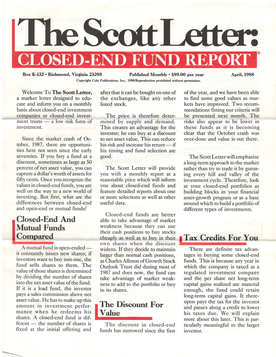
The April 1988 Scott Letter introduced closed-end funds to new investors, contrasting them with open-end mutual funds. In the wake of the 1987 crash, it highlighted deep discounts of up to 50% to NAV as rare buying opportunities. The issue emphasized fund selection, tax efficiency, historical context, and promised readers ongoing analysis, education, and recommendations.
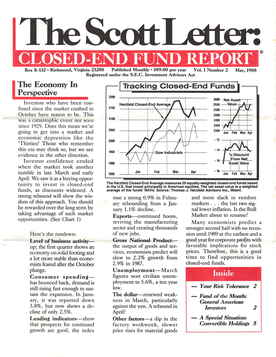
The May 1988 Scott Letter argued that the post-crash U.S. economy remained healthy, with strong consumer spending, exports, and low unemployment supporting stability. Closed-end funds were outperforming the Dow, particularly in small-cap equities. The issue stressed the importance of risk tolerance, profiled General American Investors, and pointed readers toward discounted and convertible closed-end funds as compelling opportunities.
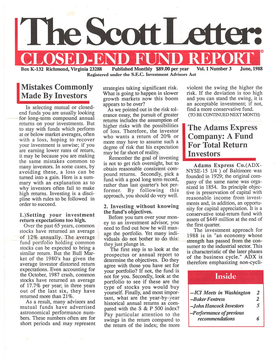
The June 1988 Scott Letter warned investors about common mistakes, including chasing unrealistic returns and ignoring stated fund objectives. It profiled Adams Express as a conservative total-return fund, highlighted Baker Fentress’s undervalued land holdings, reviewed the ICI annual meeting, and recommended John Hancock Investors Trust as a defensive bond option for those navigating market uncertainty.
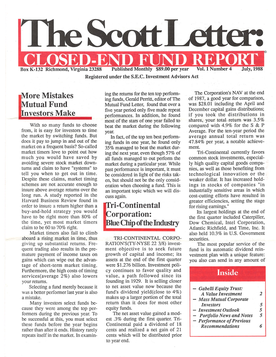
The July 1988 Scott Letter cautioned against market timing and chasing prior winners, urging patience and discipline. It profiled Tri-Continental as a blue-chip holding vehicle, praised MassMutual Corporate Investors’ strong bond performance, and reaffirmed long-term value recommendations such as Gabelli Equity Trust, Adams Express, and Baker Fentress as sound choices for investors seeking stability and growth.
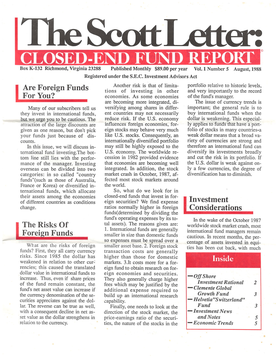
The August 1988 Scott Letter examined international investing, stressing risks like currency swings, higher expenses, and global market integration. It profiled the Clemente Global Growth Fund, still seen as a bargain at steep discounts, and the Helvetia “Switzerland” Fund as a conservative overseas option. Updates noted strong results from Adams Express, Convertible Holdings, Gabelli Equity Trust, and General American Investors.
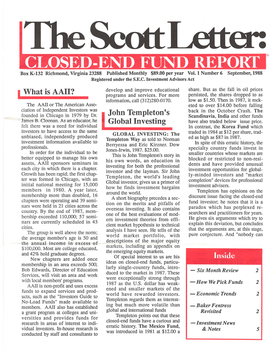
The September 1988 Scott Letter highlighted John Templeton’s global value principles and the rise of the AAII in educating individual investors. Closed-end funds posted solid first-half gains with narrowing discounts, aided by high payouts at select funds. The issue revisited Baker Fentress’s land-rich portfolio, while providing updates on Clemente Global, Convertible Holdings, and General American Investors.
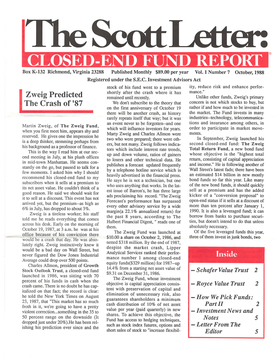
The October 1988 Scott Letter profiled Martin Zweig, who famously predicted the 1987 crash, and introduced Schafer Value Trust and Royce Value Trust as value-oriented newcomers. It cautioned against leveraged bond fund fads, updated on the Pickens challenge at Clemente Global, and urged investors to focus on asset allocation rather than market timing.
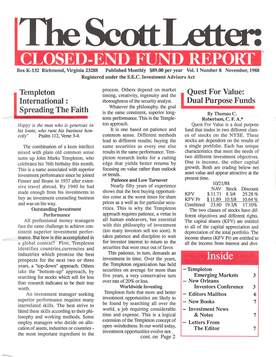
The November 1988 Scott Letter profiled John Templeton’s global value strategy, highlighting patience, low turnover, and the launch of the Templeton Emerging Markets Fund under Dr. Mark Mobius. It also reviewed Quest for Value’s dual-purpose structure, critiqued the New Orleans Investors Conference for its narrow “goldbug” focus, and noted a surge in new closed-end bond offerings.
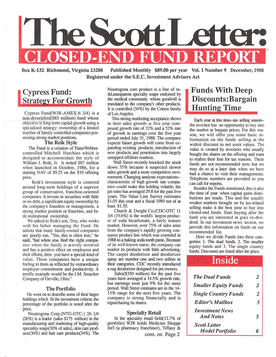
The December 1988 Scott Letter profiled the Cypress Fund, emphasizing William Reik’s strategy of concentrated investments in family-controlled, franchise-driven companies like Neutrogena and Church & Dwight. It noted the fund’s steep discount and stock repurchase program, while urging stronger dividend support. The issue also reviewed year-end tax-selling discounts, ranked top-performing funds, and questioned payout policies versus repurchase programs.
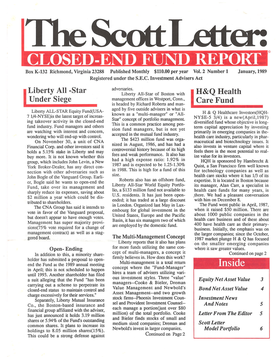
The January 1989 Scott Letter analyzed rising takeover activity in the closed-end fund sector, spotlighting Liberty All-Star Equity Fund and its multi-manager structure. It also reviewed H&Q Health Care Fund, emphasizing biotechnology and healthcare growth opportunities. The issue discussed portfolio diversification, venture capital potential, and investor caution, while forecasting continued value in disciplined closed-end fund investing.
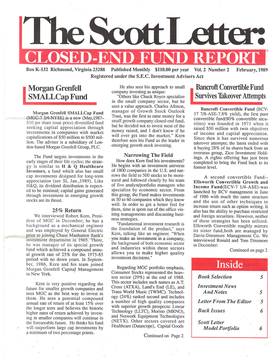
The February 1989 Scott Letter profiled the Morgan Grenfell SMALLCap Fund, emphasizing its focus on emerging growth companies and consistent long-term performance under Robert Kern. It also covered Bancroft Convertible Fund and its defense against takeover attempts. The issue reviewed convertible fund strategies, investment research discipline, and portfolio diversification, promoting patience and selective value investing amid market volatility.
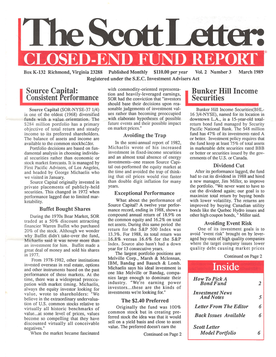
The March 1989 Scott Letter highlighted Source Capital for its consistent long-term performance and disciplined, value-driven management under George Michaelis. It also profiled Bunker Hill Income Securities, emphasizing credit quality and risk control. The issue advised investors on selecting bond funds, warning against new issues and favoring seasoned funds with low expenses, proven records, and stable management.